Listeria
Oxitrate summary of regulations, scientific implications and market impact
Based on updated EU, Lovdata and Norwegian Food Safety Authority documents as of October 2026
Executive summary
From 1 July 2026, requirements for the control of Listeria monocytogenes have been tightened for ready-to-eat foods in which the bacterium can grow. Producers must either demonstrate that levels do not exceed 100 CFU per gram throughout shelf life or ensure that Listeria monocytogenes is not detected in 25 g throughout shelf life. This is not a universal zero-tolerance requirement for all ready-to-eat foods; product category and documented growth potential are decisive.
1. What the regulations actually say
For ready-to-eat foods in which Listeria monocytogenes can grow (category 1.2), there are two regulatory routes:
| Situation | Requirement |
|---|---|
| The producer can demonstrate that L. monocytogenes does not exceed 100 CFU/g throughout shelf life | ≤100 CFU/g may be accepted throughout shelf life. |
| The producer cannot demonstrate this | L. monocytogenes must not be detected in 25 g throughout shelf life. |
Key change from the previous rules: Where a business cannot substantiate control of growth, the “not detected in 25 g” criterion no longer ends at the factory gate. From 1 July 2026, it applies throughout the shelf life of such products.
2. Why this matters scientifically
Listeria monocytogenes is a serious foodborne pathogen. Risk depends both on the vulnerability of the consumer and on the product’s capacity to support bacterial growth. The central control question is therefore not only whether Listeria is detected during production, but also what may happen to any contamination over the product’s actual shelf life.
Scientific implication: The regulations shift the emphasis from isolated end-product testing to documented control of the product, process, production environment and shelf life.
3. The product determines the risk
The Norwegian Food Safety Authority’s guidance divides ready-to-eat foods into three main categories:
- Category 1.1: products intended for infants and special medical purposes.
- Category 1.2: products in which Listeria monocytogenes can grow.
- Category 1.3: products in which Listeria monocytogenes cannot grow.
To substantiate which category a product belongs to, the business must consider, among other factors:
- pH and water activity (aw)
- salt concentration and organic acids
- preservatives or inhibitory microflora
- packaging system
- temperature and storage time
- production process, distribution and potential for contamination
Supporting documentation may include physicochemical data, scientific literature, predictive microbiology, shelf-life studies and challenge tests.
4. Relationship between the production environment, cleaning and the finished product
The documents do not establish a mathematical correlation whereby a given number of positive environmental samples can be directly converted into the probability of contamination of the finished product. They do, however, establish a clear biological and regulatory relationship:
Production environment → contamination risk → finished product → potential growth during shelf life → consumer risk
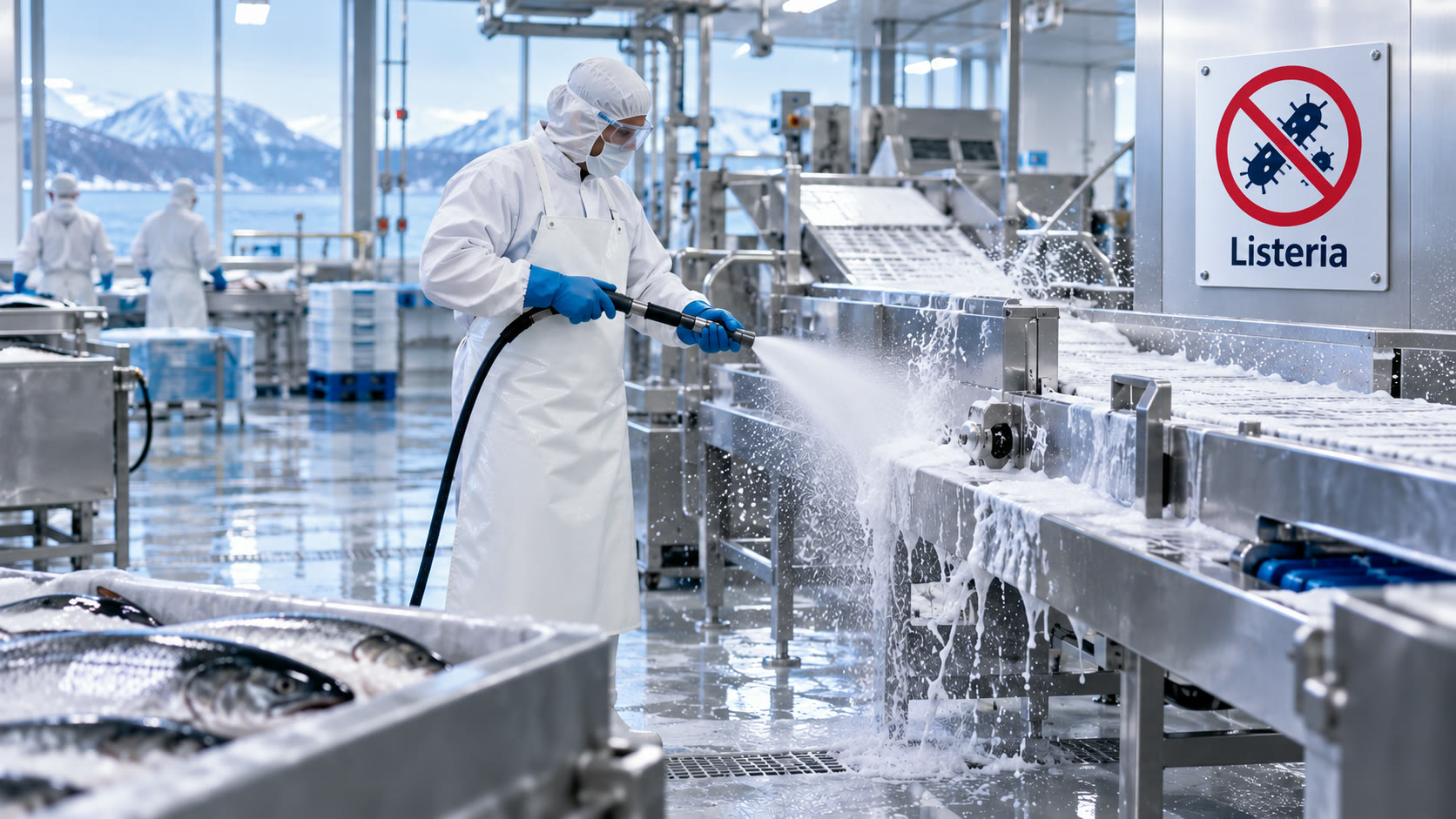
Producers of ready-to-eat foods that may present a Listeria risk must include sampling of production areas and equipment in their sampling programmes. If Listeria is detected on production equipment, the business must assess the implications for products being manufactured or already produced, and retest the equipment after cleaning and disinfection to verify cleaning effectiveness and hygienic design.
Important distinction: A positive environmental finding does not automatically mean that the finished product contains Listeria. However, the closer the finding is to food-contact surfaces or areas from which direct transfer to the product is possible, the greater its relevance to product safety and the need for risk assessment and corrective action.
5. Individual samples are not enough - trends must be analysed
EU regulations and the Norwegian Food Safety Authority’s guidance require analysis of trends in test results. Systematic failures or adverse trends must trigger action before the process goes out of control. This applies both to Listeria results and to other relevant indicators, such as pH, water activity and total viable counts from hygiene monitoring samples.
Individual sample < sampling programme < trend analysis < documented hygiene control
6. Implications for the seafood market
The change is particularly relevant to chilled, ready-to-eat products with a shelf life long enough to allow any Listeria present to grow. Smoked and cured fish are highlighted in the source material as relevant examples.
Producers must therefore be able to document an entire chain of control:
- Correct product classification.
- Controlled production environment.
- Effective cleaning and disinfection.
- Targeted environmental sampling.
- Finished-product control.
- Validated shelf life and growth potential.
- Trend analysis.
- Corrective action and documented follow-up.
7. Clarification of the phrase “below 100 CFU/g”
The statement “from 1 July 2026, producers must document that levels remain below 100 CFU/g throughout shelf life” is broadly correct, but may be misunderstood.
More precise wording:
From 1 July 2026, producers of ready-to-eat products in which Listeria can grow must either demonstrate that levels do not exceed 100 CFU/g throughout shelf life or ensure that Listeria monocytogenes is not detected in 25 g throughout shelf life.
8. Market relevance for Oxitrate
The regulatory change increases the need for documented hygiene control, but should not be presented as a universal “zero Listeria” requirement. The scientifically robust market message is that stricter product criteria increase the consequences of environmental contamination and, consequently, the requirements for documented cleaning, disinfection, monitoring and trend analysis.
Commercial rationale: Stricter product criteria → greater consequences of environmental contamination → increased need for documented cleaning and disinfection → more targeted sampling and trend monitoring → greater demand for verifiable hygiene control.
Limitation: Oxitrate should not claim that a system on its own ensures compliance with Listeria regulations. Compliance depends on the customer’s overall HACCP system, product documentation, sampling programme, shelf-life assessments and corrective actions.
9. Overall conclusion
From 1 July 2026, controlling Listeria when a product leaves the factory is no longer sufficient. For ready-to-eat products in which Listeria can grow, producers must be able to document control throughout the product’s shelf life. This makes production-environment control, cleaning and disinfection, sampling, trend analysis and documentation substantially more important.
Sources:
- Commission Regulation (EU) 2024/2895 of 20 November 2024, amending Regulation (EC) No 2073/2005 as regards Listeria monocytogenes.
- Commission Regulation (EC) No 2073/2005 on microbiological criteria for foodstuffs.
- Regulation of 1 July 2025 No. 1399 amending the Food Hygiene Regulations (Lovdata).
- Norwegian Food Safety Authority (Mattilsynet): Guidance on regulations concerning microbiological criteria, updated 2026.